



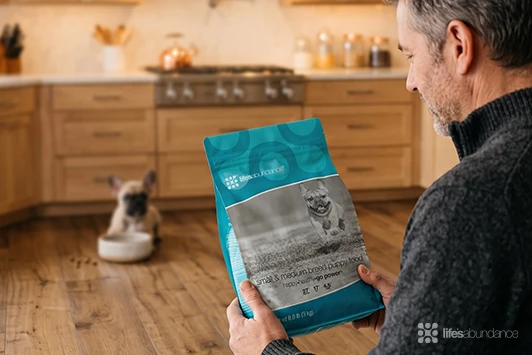
Choosing the right puppy food starts with knowing the fundamentals
Few moments in life are as exciting as bringing home a new puppy. That adorable little ball of fluff is your new sidekick! They’ll be by your side for all the big moments and the everyday ones, making all of them a little brighter.
Of course, bringing home a puppy also means having a few things to figure out.
Like finding a vet and scheduling their first visit. And there’s potty training. And teething. And puppy-proofing the house. Oh, and don’t forget trying to understand why the expensive bed you bought for them is less comfortable than the cardboard box it came in.
Then there’s nutrition.
One person says, “Keep it simple. Kibble is all they need.” Then there’s the raw food enthusiast and the canned food aficionados. And don’t forget about that stranger online touting their homemade recipe without any mention of mineral balance, nutritionist involvement, or batch testing.
It’s a lot. Especially because all you want is to provide your puppy the best possible start in life.
Here’s the truth: You don’t need to be a canine nutrition expert or follow every trend to make a confident choice. In this post, we’ll share a few fundamentals to help you cut through the noise and find a nutritional foundation for your new best friend.
Puppy Nutrition: Why The First Year Matters So Much
It might seem like your puppy spends their entire day eating, sleeping and chewing on your most prized possessions, but behind all that cuteness and mischief, there is a lot of growing going on.
We don’t mean they’re just getting bigger. Their brain and nervous system are developing to help them explore and learn everything from their name to where they’re supposed to go potty. Their bones, joints, and muscles are building the foundation for every game of fetch, backyard zoomie and outdoor adventure. Even their skin and coat are developing so you have a soft, fluffy snuggle buddy you can’t keep your hands off of.
This means their food has a big job.
Because food is the most consistent form of support they receive, choosing a strong nutritional foundation is one of the most meaningful things you can do in their first year.
What’s the Best Puppy Food?
With so many foods competing for your attention, start by looking for one formulated to meet AAFCO nutrient profiles for growth — or for all life stages, including growth.
AAFCO stands for the Association of American Feed Control Officials, an acronym worth knowing for pet parents. AAFCO develops nutrient profiles to determine whether pet foods provide complete and balanced nutrition for a particular life stage.
Here’s why “complete and balanced” matters:
Complete foods cover the full range of essential nutrients a growing puppy needs
Balanced means the nutrients are in the right amounts and proportions so they can work together as intended
A complete formula accounts for protein and essential amino acids, fatty acids like DHA, carefully balanced minerals like calcium and phosphorus, and other vitamins and nutrients puppies need.
But making sure the food is complete and balanced is only the starting point. The next step is to check and see if the food passed an AAFCO-recognized feeding trial.
Feeding trials evaluate how a food performs when dogs actually eat it during a structured process. Instead of relying on the recipe formulation alone, feeding trials substantiate that the food actually delivers the complete and balanced nutrition your puppy needs.
Fortunately, you don’t have to become an expert on every nutrient in your puppy’s bowl. Start with complete and balanced nutrition, then take a step further and check to see if the food passed a feeding trial. It’ll give you the confidence that the food you choose is helping fuel all the growing and mischief ahead.
Different Sizes, Different Needs
The cute little puppy you see today won’t stay little forever — cute, absolutely, but little? Probably not. And how big they’re expected to get makes a difference. Puppies of different sizes have different nutritional needs.
For example, small and medium-sized puppies generally mature faster and may reach their adult size around 10–12 months, while large and giant breeds can continue growing for 18–24 months.
And that difference matters. Large and giant breed puppies require nutrition that supports slower, more controlled growth over their longer development period. Growing too quickly can place extra stress on their developing bones and joints, which is why the balance of calories and minerals such as calcium and phosphorus deserves particular attention in large-breed puppy food.
Not sure where your puppy fits? Here’s a general guide based on expected adult weight:
Small breeds: Roughly 25 lbs. or less
Medium breeds: Roughly 26–69 lbs.
Large breeds: 70 lbs. or more
These ranges are approximate, but they can help point you in the right direction. Once you have an idea of how big your puppy is expected to become, look for food made to support that growth pattern. Small and medium-breed puppy food supports their shorter path to maturity, while large-breed puppy food is designed to support a longer period of slower, controlled growth.
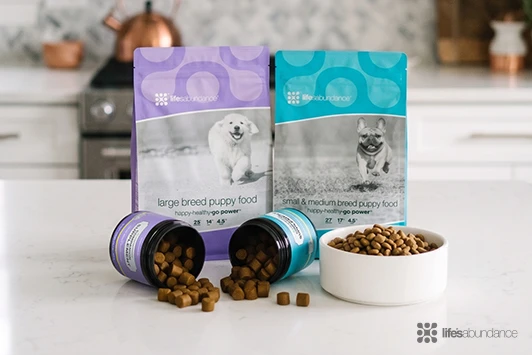
Custom-made dog food supplements to optimize every meal
Puppy Supplements — Do You Need Them?
A complete and balanced puppy food formulated to meet AAFCO nutrient profiles gives your puppy the essential nutrition they need as they grow into a happy, healthy adult.
But some puppy parents look at that adorable little face and think, “Okay…but what else can I do?” We get it. We’re totally those people. And this is usually the point where new pet parents discover the world of supplements.
Supplements can be a great way to add targeted support, but adding one to a complete and balanced diet can throw your puppy’s nutrition out of balance. Generic supplements have no way of knowing what nutrients are already in your puppy’s bowl — how could they?
That’s what makes Life’s Abundance Puppy Companion Supplements so unique. The Companion Supplement for Small & Medium Breed Puppy Food and the Companion Supplement for Large Breed Puppy Food are each custom-made to pair with their matching puppy food.
We test the food first, then build the supplement around what is already there so there’s no guessing or simply piling more nutrients on top of the recipe. We intentionally add extra support while helping prevent unnecessary overlaps or imbalances.
Each chew delivers 28+ active ingredients across eight key systems: joints & mobility, gut health & digestion, skin & coat, immune system, stress & cognition, liver function, antioxidant & vitality and metabolic & cardiovascular.
If you decide to supplement, choose something formulated with your puppy’s food in mind. Life’s Abundance removes the guesswork by pairing each complete and balanced puppy food with a Companion Supplement designed around it — for parents who want more support without blindly piling on more nutrients.
Those Puppy Training Treats Count, Too
Puppies have an uncanny ability to earn extra treats. They went potty outside? Treat. They looked extra cute while they yawned? Treat. They briefly considered leaving your shoes alone? Honestly, that one does deserve a treat.
Treats are enormously useful during puppy training, but even those tiny bites count toward your puppy’s daily nutrition. AAFCO (remember them?) cautions that too many treats can imbalance an otherwise complete and balanced diet.
As a general rule, treats should not make up more than 10% of your puppy’s daily calories.
A few simple habits to help:
Choose wholesome dog treats made with quality ingredients — including single-ingredient treats
Break larger treats into smaller, puppy-sized training pieces
Keep track of treats given by everyone in the household
Use pieces of their puppy food as rewards instead
You don’t have to deny that sweet little face every time they ask. Just remember: treats are part of the nutritional picture — even when your puppy insists they don’t count.
Picking Puppy Food Doesn’t Have to Be Complicated
There will always be another new trendy food recommendation, a heated ingredient debate or an excessively confident opinion awaiting you online.
But the vast majority of that is just noise. These fundamentals help keep it simple:
Start with complete and balanced nutrition formulated to meet AAFCO nutrient profiles
Choose an all life stage food or one for your puppy’s expected adult size — small, medium or large
Consider the entire formula, not just one trendy or impressive ingredient
Choose a supplement made to work with the food in your puppy’s bowl
Remember: training treats count toward their daily calories
And just like that, you have one less new-puppy mystery to solve.
Now you can get back to potty training, feeding routines, socializing and explaining for the hundredth time why socks are not food.
It feels like a lot, but these chaotic little moments have a funny way of becoming the memories you treasure most. Have tons of fun with your new best friend — and give them an extra pet from all of us at Life’s Abundance!