




Give your skin barrier some credit. It does a lot for healthy skin.
You don’t have to be a skincare fanatic to recognize the term “skin barrier.” It’s started to show up everywhere: on product labels, in ingredient deep dives and in plenty of videos claiming to reveal what you absolutely should and should not be putting on your face.
And unlike many skincare trends, there's a good reason the skin barrier keeps coming up.
But the way it’s talked about can make it sound too simple and passive, like it’s nothing more than a canvas for your skincare routine. A simple surface you’re solely responsible for keeping healthy and looking its best.
Your skin deserves more credit than that.
Most people think of the skin barrier as a shield, keeping unwanted things out and precious moisture in. That shield-like role is important, but there’s a whole lot more happening within your skin barrier than keeping things in or out. Your skin barrier is a dynamic environment of interconnected systems shaped by moisture, oils, pH, microorganisms and the products you put on every day. All of that behind-the-scenes work helps create conditions for your skin to stay hydrated, comfortable and resilient.
And there are two parts of the skin’s environment worth knowing by name: the acid mantle and your skin’s microbiome.
They might sound like skincare buzzwords. But once you understand what they are — and how the products you use interact with them — you’ll start to see how a product interacts with your skin can matter just as much as what it promises to do for it.
What Is the Acid Mantle and Why Does It Matter for Skincare?
Acid mantle might sound like something you’d want nowhere near your face, but it’s actually an important part of a healthy skin barrier.
Your skin naturally maintains an acidic environment, helping create the right conditions for your barrier to do some of its most important work. Think of it like Goldilocks and the Three Bears: your acid mantle helps keep things in the “just right” zone. That includes supporting enzymes involved in processing the barrier lipids that slow moisture loss and helping old skin cells shed normally.
When that pH gets pushed too far out of its preferred range, you may notice it in ways that feel a lot more familiar: dryness, tightness, roughness, flaking or irritation.
In simpler terms, your acid mantle helps support both the seal that keeps moisture in and the natural turnover that keeps rough, flaky cells from overstaying their welcome.
So where does your skincare routine fit into all of this?
Every cleanser, serum, moisturizer and treatment you apply comes into contact with a surface that already has its own preferred pH, and different formulas can interact with that environment in different ways. Cleansing in particular can temporarily shift pH levels.
That’s where pH-balanced skincare starts to make more sense. Formulating for your skin’s natural pH can help minimize unnecessary disruption to the acid mantle your skin works to maintain.
And your skin isn’t the only thing that prefers those conditions. The tiny community of microorganisms living there does too — which brings us to your skin microbiome.
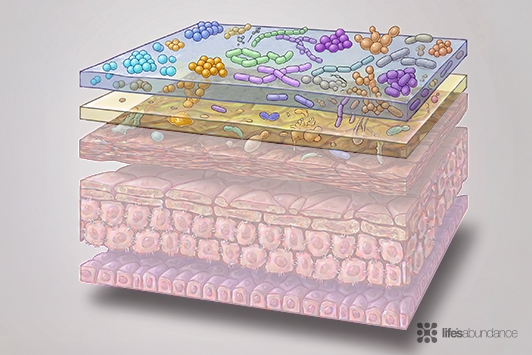
Go deeper into your skin barrier: meet the acid mantle and microbiome.
What Is the Skin Microbiome and What Does Skincare Have to Do With It?
Your skin may look like a calm, quiet place, but it’s home to billions of microscopic organisms.
Bacteria, fungi and other microorganisms make up your skin microbiome. And before the word “bacteria” sends you reaching for the cleanser, don’t — healthy skin isn’t supposed to be sterile. Many of these microbes are native residents that work with your skin barrier to help maintain the conditions healthy skin relies on.
How the Microbiome Supports Your Skin
Supports your skin barrier — resident microbes interact with skin cells and help support moisture retention, comfort and resilience
Helps keep disruptive microbes in check — when bad microbes gain too much ground, they can contribute to irritation, barrier disruption and breakouts
Works alongside your acid mantle — your microbiome lives within the acidic environment your acid mantle helps maintain, making both part of the same interconnected skin-barrier system
Everything you put on your skin becomes part of that environment, which means your skincare routine influences the conditions your microbiome lives within.
That’s why microbiome-friendly skincare matters. It’s formulated to work with the natural systems already supporting your skin, rather than treating your skin like a problem to be solved. Because good skincare shouldn’t have to choose between delivering results and respecting the barrier, acid mantle and microbiome already doing their part.
What Does All This Mean for Your Skincare Routine?
Once you understand what your skin is already doing behind the scenes, it’s worth taking another look at how the products in your routine fit into that picture.
Your skin barrier isn’t a blank canvas waiting for skincare to fix it. It already has an acid mantle maintaining its preferred pH and a microbiome helping keep its environment balanced.
So when you choose skincare, look for products designed with those systems in mind — including pH-balanced and microbiome-friendly formulas that can deliver the benefits you want without unnecessarily working against your skin.
Your skin already has plenty of skin in the game. Your skincare might as well play on the same team.